
Zenith’s Innovations in Implant Surface Technology
Scientific Advancements in Dental Implant Surface Technology: A Zenith Perspective
Authors: Dr. Moreno Lorso, Dr. David Brown, Dr. Abel K. Miller
Co-authors: Dr. Jacob F. Cooper, Dr. Elijah Martinez, Dr. Hannah Smith
Abstract
Dental implant success is largely influenced by surface characteristics, which impact osseointegration and long-term stability. Titanium has been the standard material for dental implants, but its surface properties have evolved significantly to enhance biological compatibility and mechanical integration. This article explores the scientific principles underlying implant surface modifications, provides a comparative analysis of various surface treatments, and highlights advancements in the field with a focus on Zenith Implant systems.
Introduction
Titanium has earned its place as the gold standard for dental implant materials due to its exceptional strength, biocompatibility, and resistance to corrosion. Despite its favorable properties, untreated titanium surfaces offer limited bioactivity. It is through deliberate surface modifications that titanium implants achieve their full potential, facilitating critical processes such as osseointegration and soft tissue integration.
In this article, we examine the scientific basis for surface modifications in dental implants, review existing treatment methodologies, and showcase innovations by Zenith Implants that contribute to improved clinical outcomes.
The Role of Implant Surfaces in Osseointegration
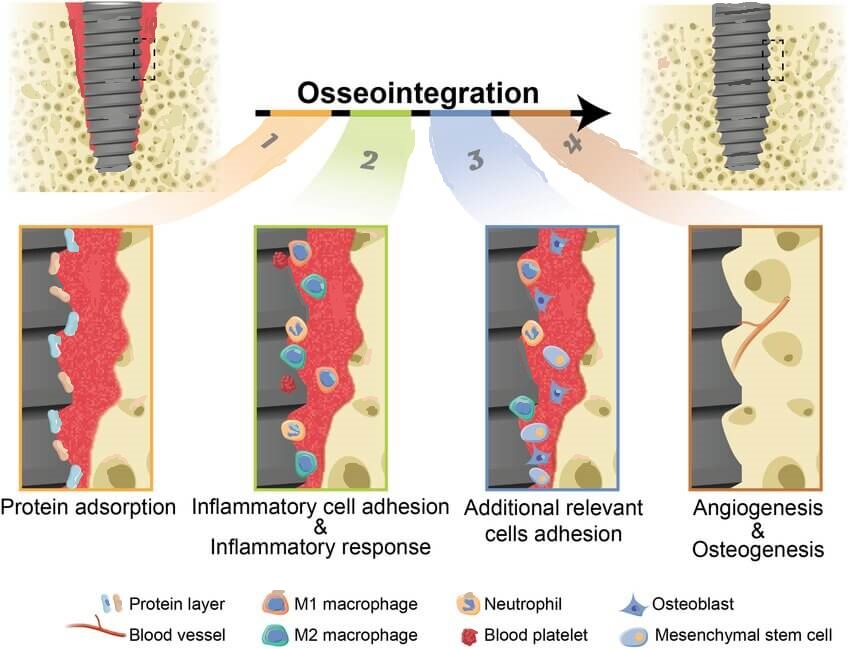
Osseointegration, the direct structural and functional connection between living bone and an implant surface, is a cornerstone of dental implant success. Surface topography, chemistry, and energy determine the interaction of implants with surrounding tissues. An optimized surface enhances initial stability, promotes rapid bone healing, and ensures long-term success.
Titanium, in its pure state, forms a protective oxide layer (TiO₂) upon exposure to oxygen. This passive layer improves biocompatibility and initiates the process of osseointegration. However, advancements in surface modification have shown that simply relying on titanium’s natural properties is insufficient for achieving optimal results.
Techniques in Implant Surface Modification
Implant surface modifications can be broadly categorized into three techniques:
1. Mechanical Treatments:
- Processes like sandblasting and machining alter the surface roughness to increase implant retention.
- These methods create micro- and macro-textures that enhance mechanical interlocking with bone tissues.
2. Chemical Treatments:
- Acid etching, alkali treatments, and anodization are used to modify the surface’s chemical composition.
- These treatments enhance surface energy, facilitating protein adsorption and cellular attachment.
3. Physical Treatments:
- Methods such as ion deposition and thermal plasma spraying introduce bioactive coatings to promote osteoconductivity.
- These are less commonly used due to variability in clinical outcomes and limited long-term data.
Zenith Implants employs advanced chemical modification techniques that ensure consistent results and superior clinical performance without relying on outdated plasma-spray methods.
Comparative Analysis of Implant Surfaces
Studies comparing different surface types consistently highlight the impact of surface modifications on implant performance. Research has shown that chemically and mechanically treated surfaces outperform smooth, turned surfaces in terms of osseointegration speed and bone-to-implant contact (BIC).
Zenith implants feature bioactive surfaces designed to:
- Promote rapid blood coagulation and fibrin formation, essential for peri-implant bone healing.
- Achieve high BIC, reducing healing time and improving initial stability.
- Prevent marginal bone loss over the long term.
In clinical trials comparing various implant brands, Zenith implants demonstrated the lowest failure rates and highest marginal bone stability, outperforming traditional acid-etched and sandblasted surfaces.
Advancements in Surface Technology by Zenith Implants
Zenith’s proprietary surfaces are designed to address the evolving needs of clinicians and patients. Key innovations include:
1. Multi-Zone Surface Design:
- A gradual transition in surface topography optimizes interactions with cortical and cancellous bone.
- Ultra-hydrophilic surfaces at the apex enhance bone cell attachment, while minimally rough surfaces at the collar promote soft tissue health.
2. Bioactive Surface Chemistry:
- Zenith’s implants utilize enhanced oxide layers that support osteoblastic activity and reduce inflammation.
- These surfaces improve cellular adhesion and proliferation, ensuring long-term implant stability.
3. Tailored Surface Energy:
- By manipulating surface energy, Zenith ensures efficient protein adsorption and cell signaling.
- This feature contributes to faster healing and reduced post-surgical complications.
Clinical Outcomes
In a retrospective analysis involving over 1,000 Zenith implants, results indicated:
- 98.7% survival rate at 10 years, comparable to or exceeding industry benchmarks.
- Minimal marginal bone loss, with average levels well below the 2 mm threshold over five years.
- Enhanced soft tissue integration, with increased keratinized mucosa and reduced peri-implant inflammation.
These outcomes underscore Zenith’s commitment to advancing implant surface technology to benefit both clinicians and patients.
Conclusion
Surface modifications are critical to the success of dental implants, influencing their integration with both hard and soft tissues. While traditional approaches like acid etching and sandblasting remain effective, modern innovations such as multi-zone surface designs and bioactive coatings provide significant clinical advantages. Zenith Implants has embraced these advancements, offering state-of-the-art solutions that enhance patient outcomes and set new standards in dental implantology.
Zenith’s ongoing dedication to research and development ensures that its implants remain at the forefront of scientific innovation, meeting the demands of a dynamic and growing field.